Smart Wasted Food
Less waste.
More value.
A special menu concept that transforms usable surplus ingredients into desirable dishes for sushi restaurant customers.
01 / overview
Turning surplus into customer value
Smart Wasted Food explores how sushi restaurants can reduce food waste through a special menu that gives usable surplus ingredients a second purpose.
The context
Fresh fish, vegetables, fruit, and prepared rice have short usable lives. Restaurants prepare extra to avoid shortages, but their regular menus offer limited ways to use what remains.
The central question
Could food waste be transformed into customer value instead of operational loss?
02 / problem
Usable ingredients, without a clear next step
The problem is not always spoilage. Ingredients can still be usable when they are discarded because there is no structured way to repurpose them.
Availability comes first
Uncertain demand encourages overpurchasing and overpreparation. Maintaining freshness and avoiding shortages often take priority over ingredient utilization.
Waste across the operation
Surplus accumulates during storage, preparation, and after service. Discarding it creates financial loss and environmental impact.
A gap in existing approaches
Donation, discounted surplus, and waste tracking address what happens after surplus exists. This project focuses on recovering its value before it becomes waste.
03 / research
Understanding the restaurant from both sides
Eight interviews included one chef, one general manager, two managers, two waiters, and two customers. Contextual observation, semi-structured interviews, workflow analysis, and customer surveys informed the research.
Operations
How is demand forecast? What drives purchasing decisions? Where does waste appear during a typical day?
Customer expectations
How do customers perceive surplus ingredients, portions, freshness, and value?
Research focus
The investigation followed ingredients through purchasing, storage, preparation, consumption, and disposal to identify a practical intervention point.
04 / stakeholders
Balancing quality, service, and profitability
The service involves people with different priorities. A useful solution must fit the kitchen and management workflow while remaining desirable to customers.
Owner · General manager · Chef
Owners prioritize profitability and brand reputation. Managers balance inventory and costs. Chefs protect freshness and quality while preparing enough for service.
Supplier
Stable orders and long-term relationships matter, while changing demand complicates supply planning.
Customer · Waiter · Cashier
Customers expect freshness, fair prices, and appropriate portions. Front-of-house staff need a clear offer that is easy to explain and serve.
05 / insights
The opportunity starts before disposal
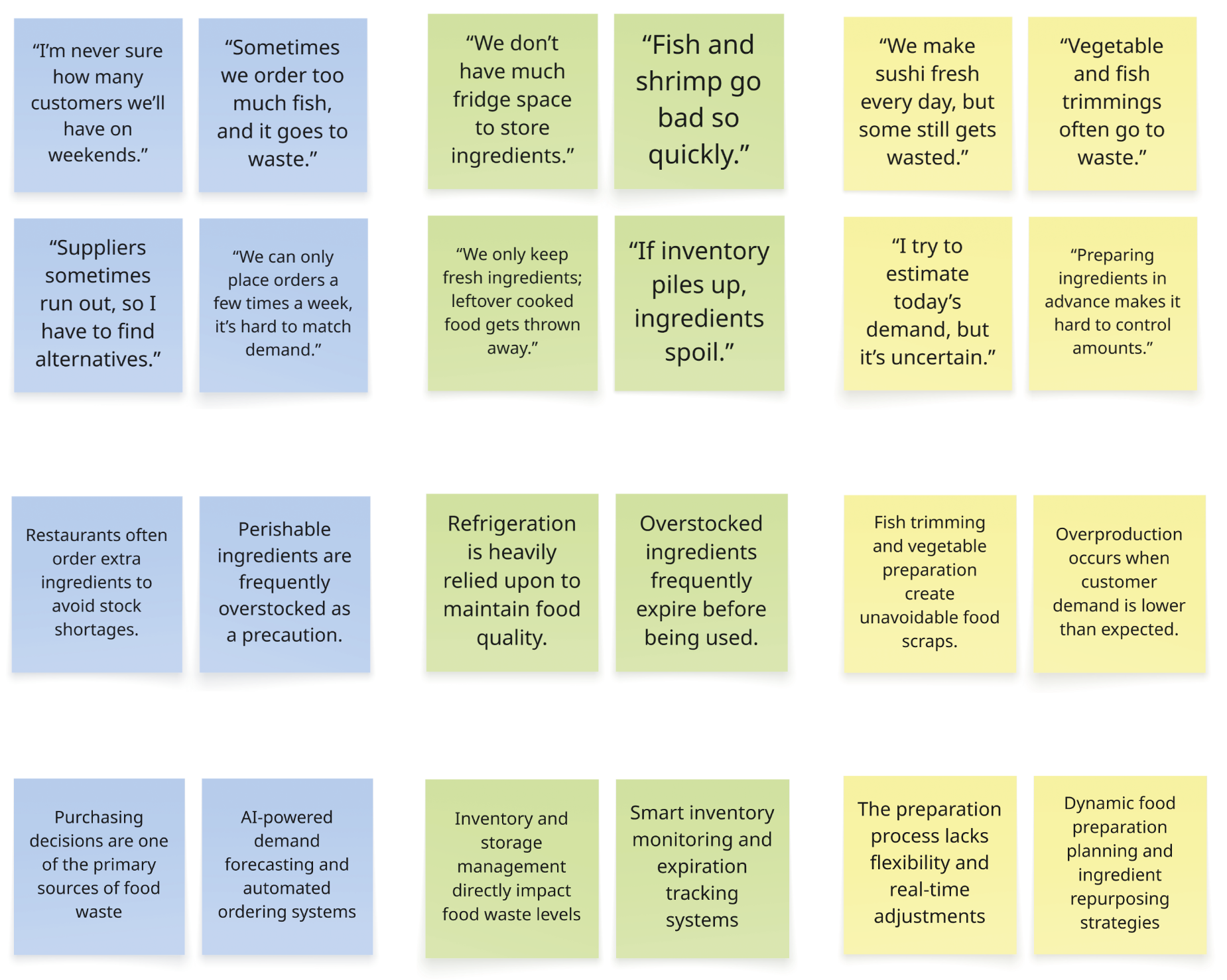
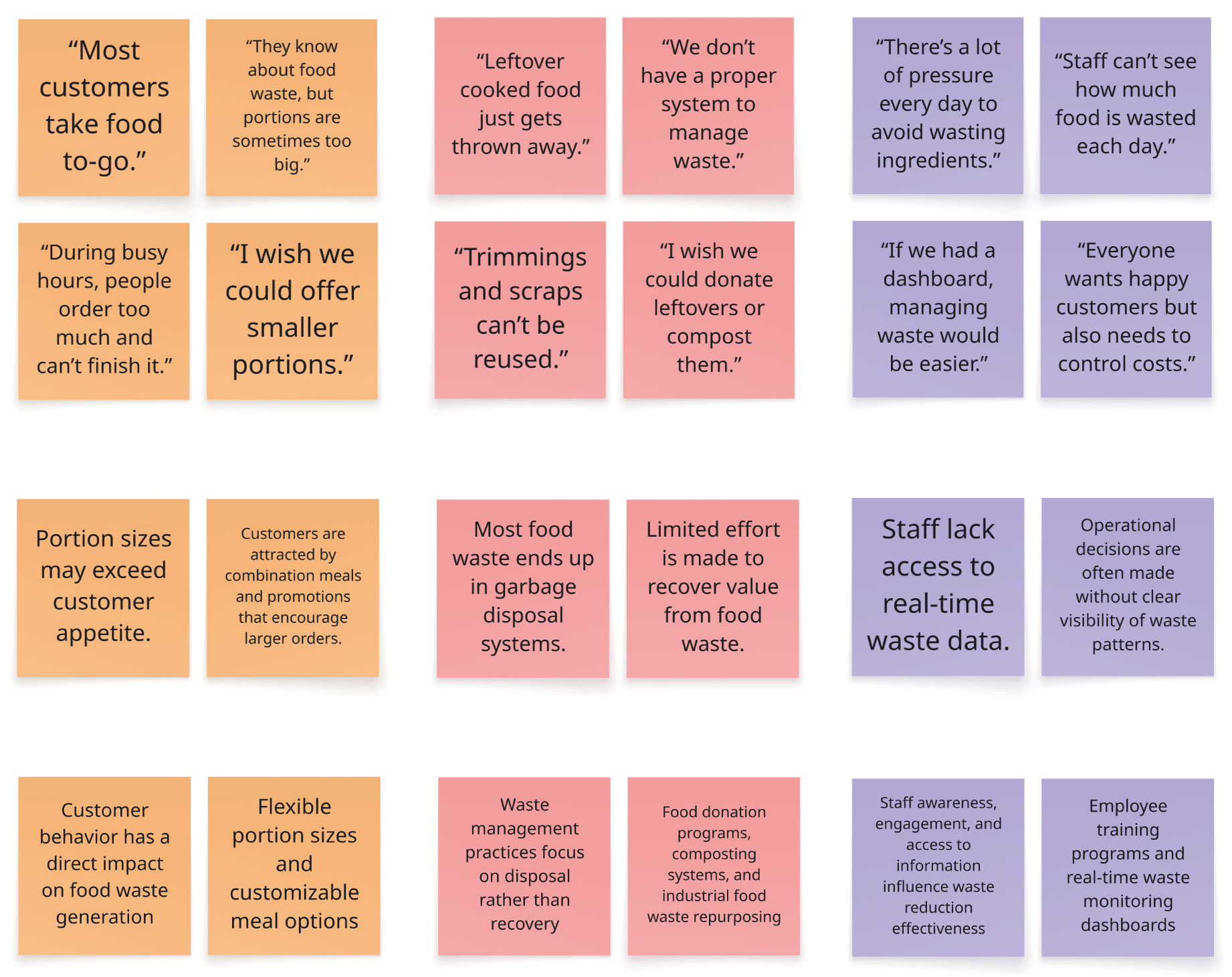
Affinity mapping connected observations across ordering, storage, preparation, customer behavior, waste handling, and staff responsibilities.
Uncertainty drives excess
Overordering and overproduction act as a buffer against unpredictable demand. Waste becomes an accepted tradeoff for availability.
Surplus remains valuable
Fish, rice, vegetables, and fruit are recurring opportunities for reuse while they remain suitable for serving.
Waste is often invisible
Sales are tracked more consistently than waste. Disconnected steps make it difficult to see and recover surplus across the ingredient lifecycle.
Prevention needs an operational fit
A new use for ingredients must protect quality, respect customer expectations, and integrate into existing kitchen routines.
06 / persona
Designing for the restaurant manager
David Chen is a research-informed persona representing the manager balancing daily service, inventory, staffing, and food costs.
Profile
Age 38 · Atlanta, Georgia · 12 years of restaurant experience · A midsized sushi restaurant with 15 employees.
Goals and frustrations
Reduce waste without compromising quality, improve utilization, and protect margins. Unpredictable demand and limited reuse options make this difficult.
Behaviors and motivations
Uses sales trends and experience to purchase ingredients, keeps buffer stock, and favors practical improvements that fit everyday operations.
In his words
“I know some ingredients will be left over. The challenge is finding a way to use them before they become waste.”

David Chen
Restaurant Manager · Atlanta, GA
07 / empathy
A daily tension between enough and too much
The empathy map reveals a manager who wants to reduce waste but cannot risk disappointing customers or disrupting service.
Sees and hears
Demand fluctuates, perishables are costly, and surplus accumulates. Owners ask for lower costs, kitchen staff need stock, and customers expect freshness.
Says and does
Orders extra for safety, monitors freshness, coordinates preparation, and discards surplus that has no place on the menu.
Thinks and feels
Frustrated by usable food being wasted and concerned about costs. Motivated to improve, but needs confidence that a solution will work in practice.
08 / journey
Following ingredients through the service
The activity map, sequence map, and service blueprint identify a missing recovery step between preparation and disposal.
The customer experience
Customers browse, order, eat, and leave. Front-of-house staff take orders and serve dishes, while chefs prepare them.
Behind the service
Managers forecast, purchase, and monitor inventory. Kitchen staff store and prepare ingredients, then review and dispose of what remains.
The critical gap
At the end of service, ingredients may still be usable. Without a defined reuse pathway, that value is lost before the next service.
| Stage | Activity | Pain point |
|---|---|---|
| 01 · Forecast | Manager reviews sales and estimates demand. | Uncertainty encourages a safety buffer. |
| 02 · Purchase | Manager orders fish, rice, vegetables, and fruit. | Overordering creates excess inventory. |
| 03 · Receive & store | Staff receive, refrigerate, and monitor ingredients. | Short shelf life limits the recovery window. |
| 04 · Prepare | Chefs portion ingredients and prepare for service. | Peak-hour expectations encourage overpreparation. |
| 05 · Serve & consume | Staff serve customers who eat in or take away. | Portion sizes and actual consumption can differ. |
| 06 · Review surplus | Manager and chef identify unused ingredients. | Still-usable ingredients lack a defined next use. |
| 07 · Dispose | Staff remove expired or unusable ingredients. | Value is lost without an earlier recovery step. |
09 / opportunity
Create a recovery step that fits the kitchen
How might we help sushi restaurants transform surplus ingredients into desirable menu items before they become waste?
Protect quality
Repurpose ingredients while they are still suitable for serving and maintain customer expectations for freshness.
Minimize disruption
Build on existing ingredients and preparation workflows instead of introducing a separate, burdensome process.
Make sustainability desirable
Offer customers appealing dishes while creating an opportunity to recover business value.
10 / concepts
Comparing three ways to recover value
Concept development considered how each approach could reduce waste while supporting the restaurant’s operation.
01 · Discount surplus
Easy to introduce and potentially useful for immediate surplus, but may lower perceived value and is limited as a long-term approach.
02 · Donate ingredients
Creates social value, but does not recover restaurant revenue and can be difficult to scale within the operation.
03 · Special Waste Menu
Transforms surplus into intentional dishes. Selected for its potential to improve ingredient utilization, fit existing workflows, and create customer value.
11 / solution
A special menu, built around usable surplus
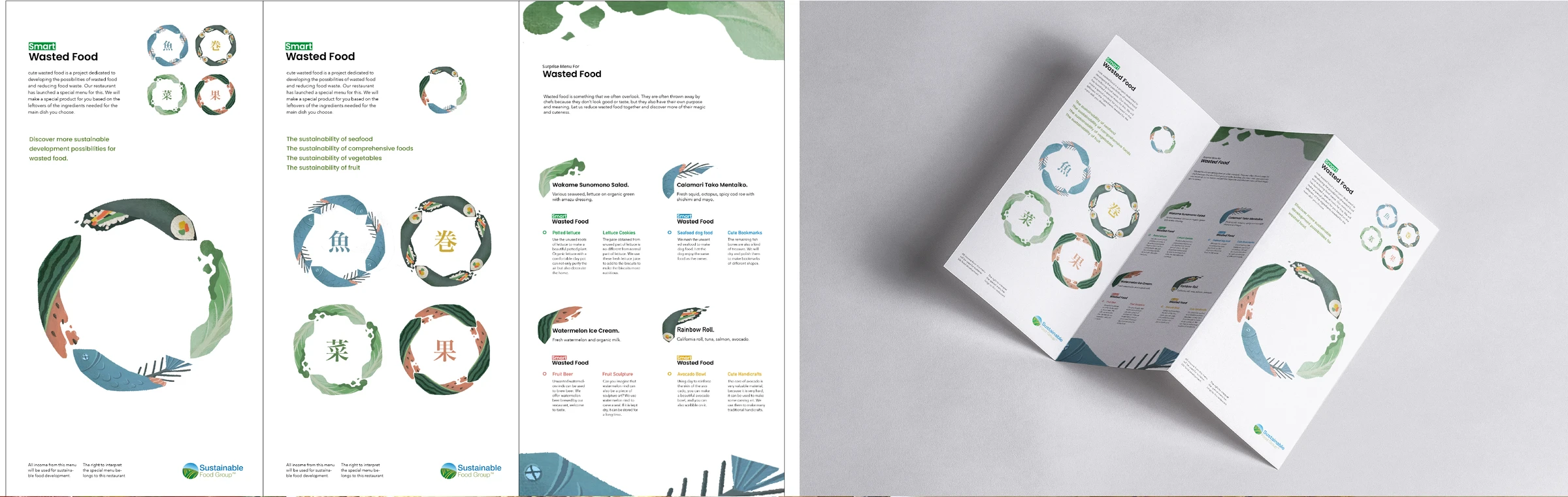
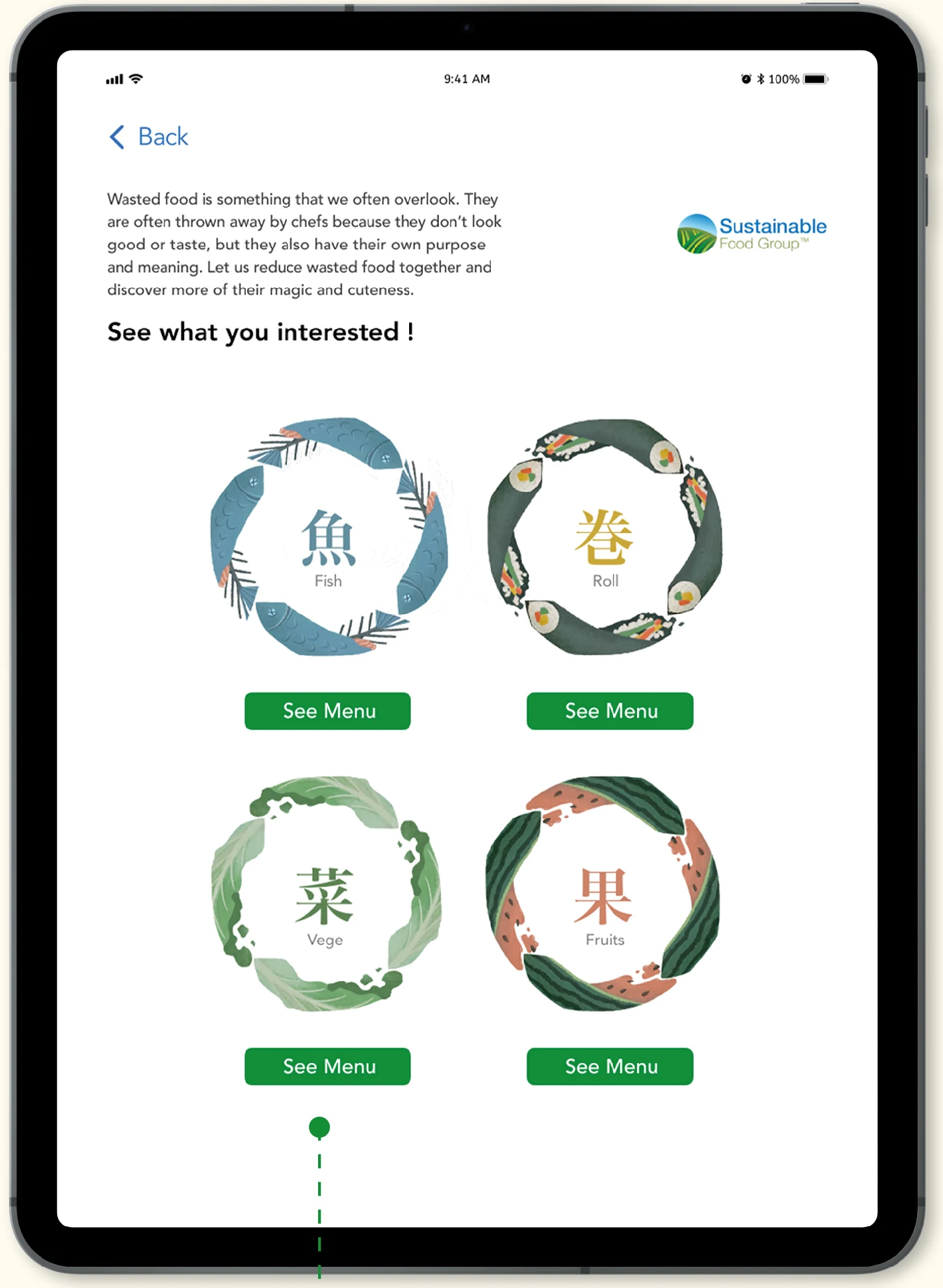
The final design direction organizes frequently wasted ingredients into a special menu, creating a pathway to use them before disposal.
Fish Specials
Give suitable surplus fish an intentional place in the menu.
Rice & Roll Specials
Use prepared rice and compatible ingredients in additional menu options.
Vegetable Specials
Create desirable dishes around vegetables that would otherwise remain unused.
Fruit Specials
Extend the usefulness of available fruit through dedicated specials.
The intended value
The concept aims to reduce waste, improve ingredient utilization, and generate additional revenue. These are proposed benefits, not measured production outcomes.
13 / Special menu
Four ingredients. One circular story.

14 / Special menu
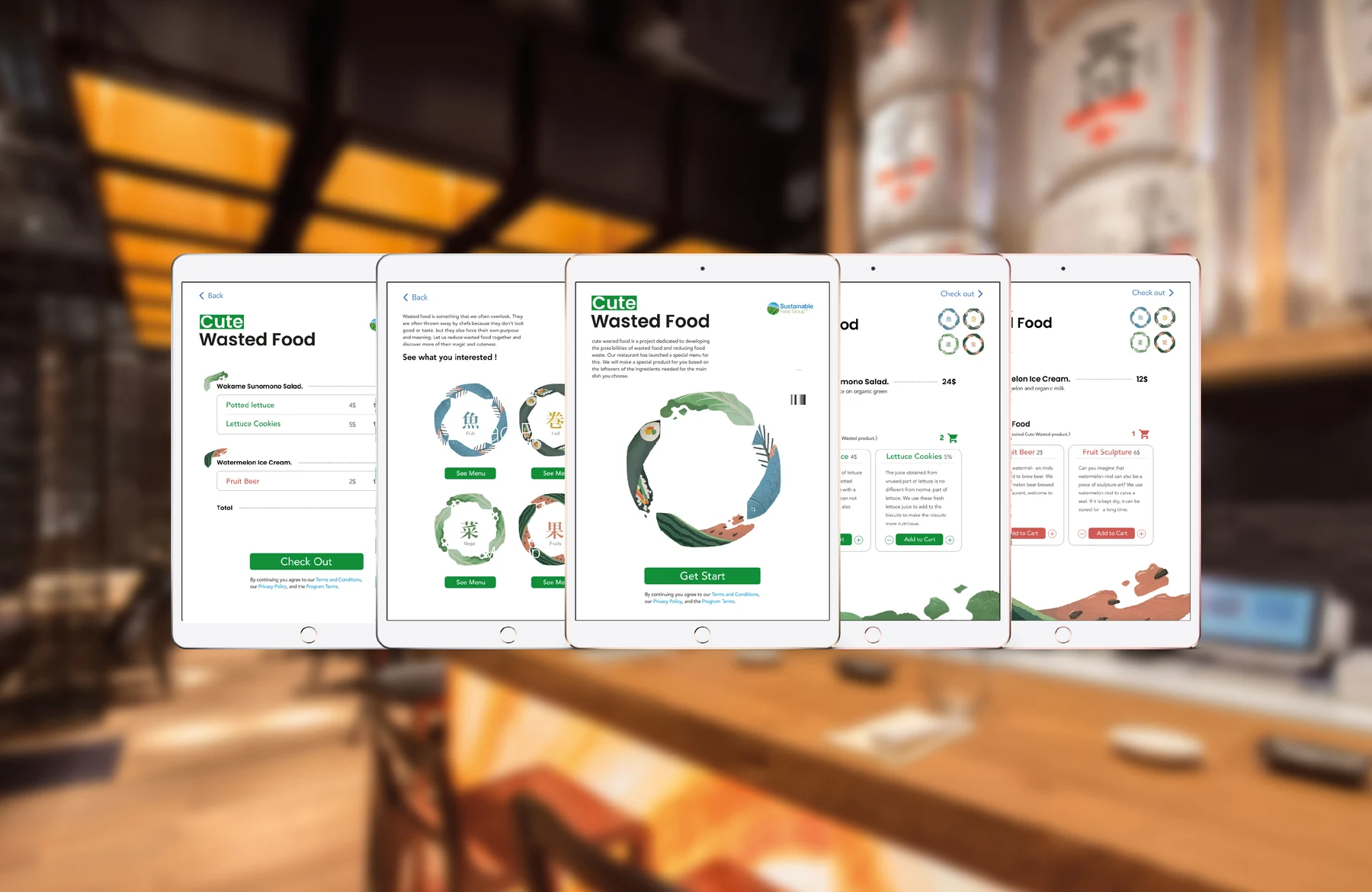
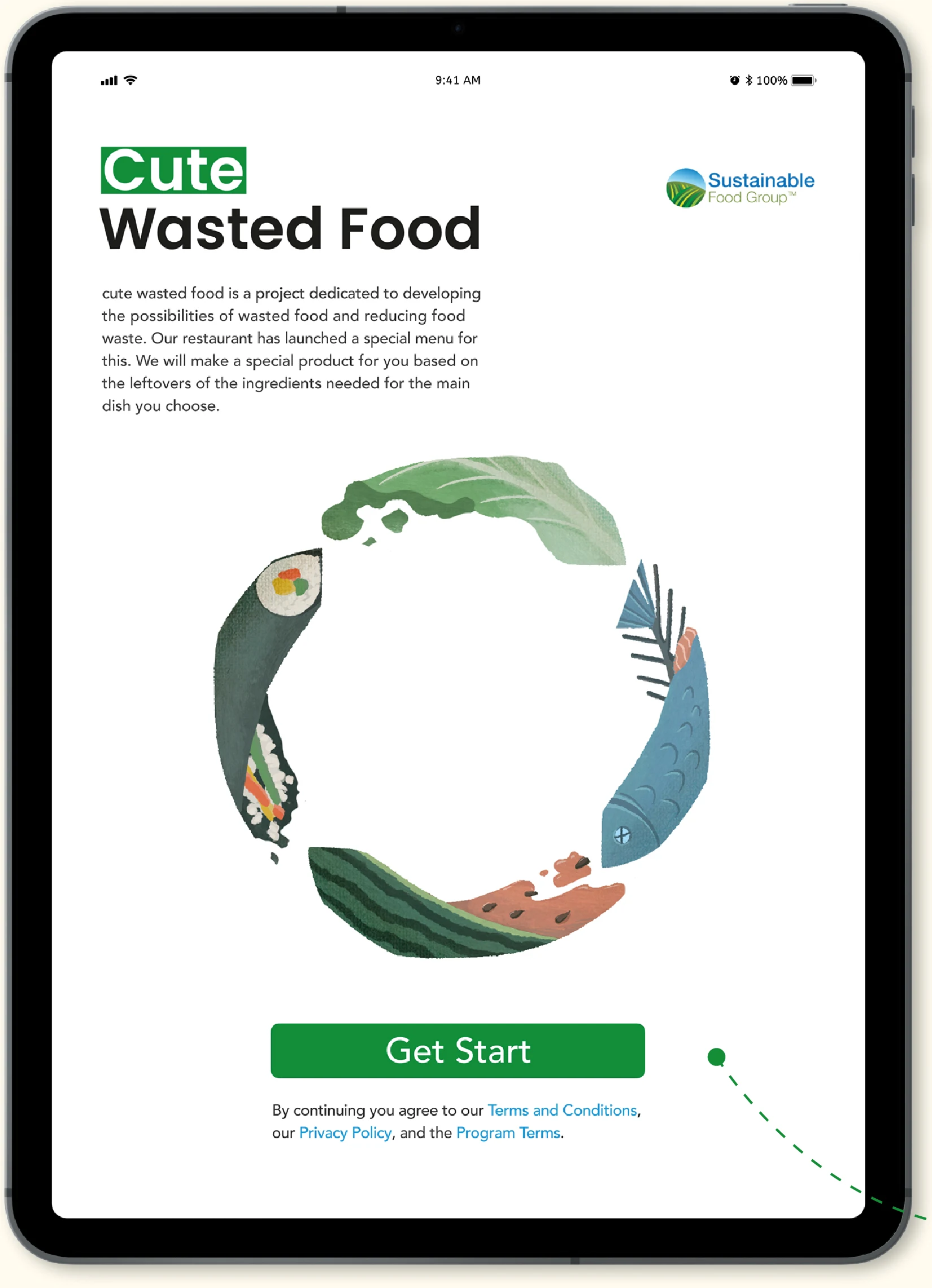
01 — Introduce the menu
15 / Special menu
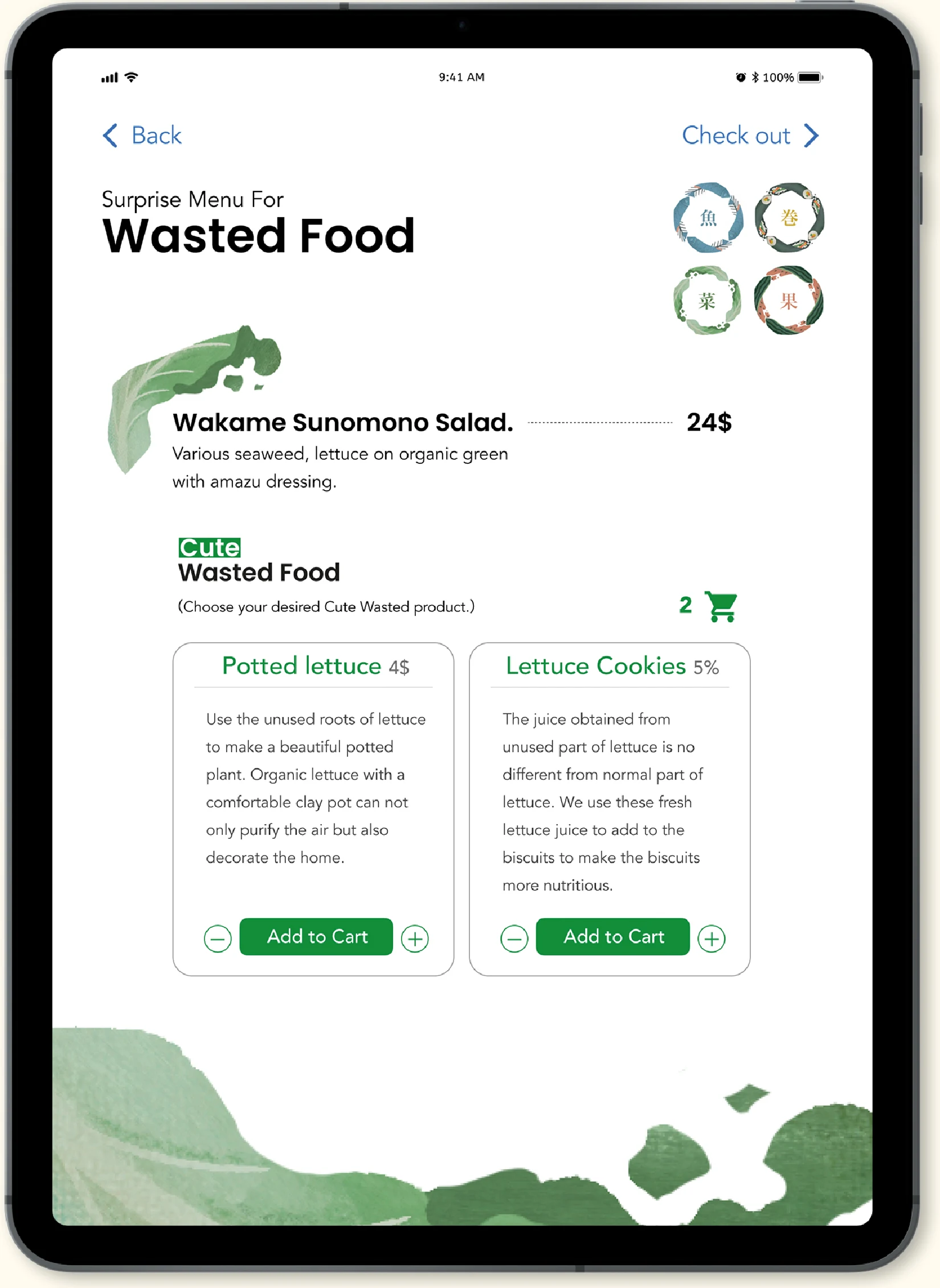
02 — Explore dishes and their second possibilities
Wakame Sunomono Salad
A salad paired with ideas for using lettuce roots and juice.
Potted lettuce · Lettuce cookies
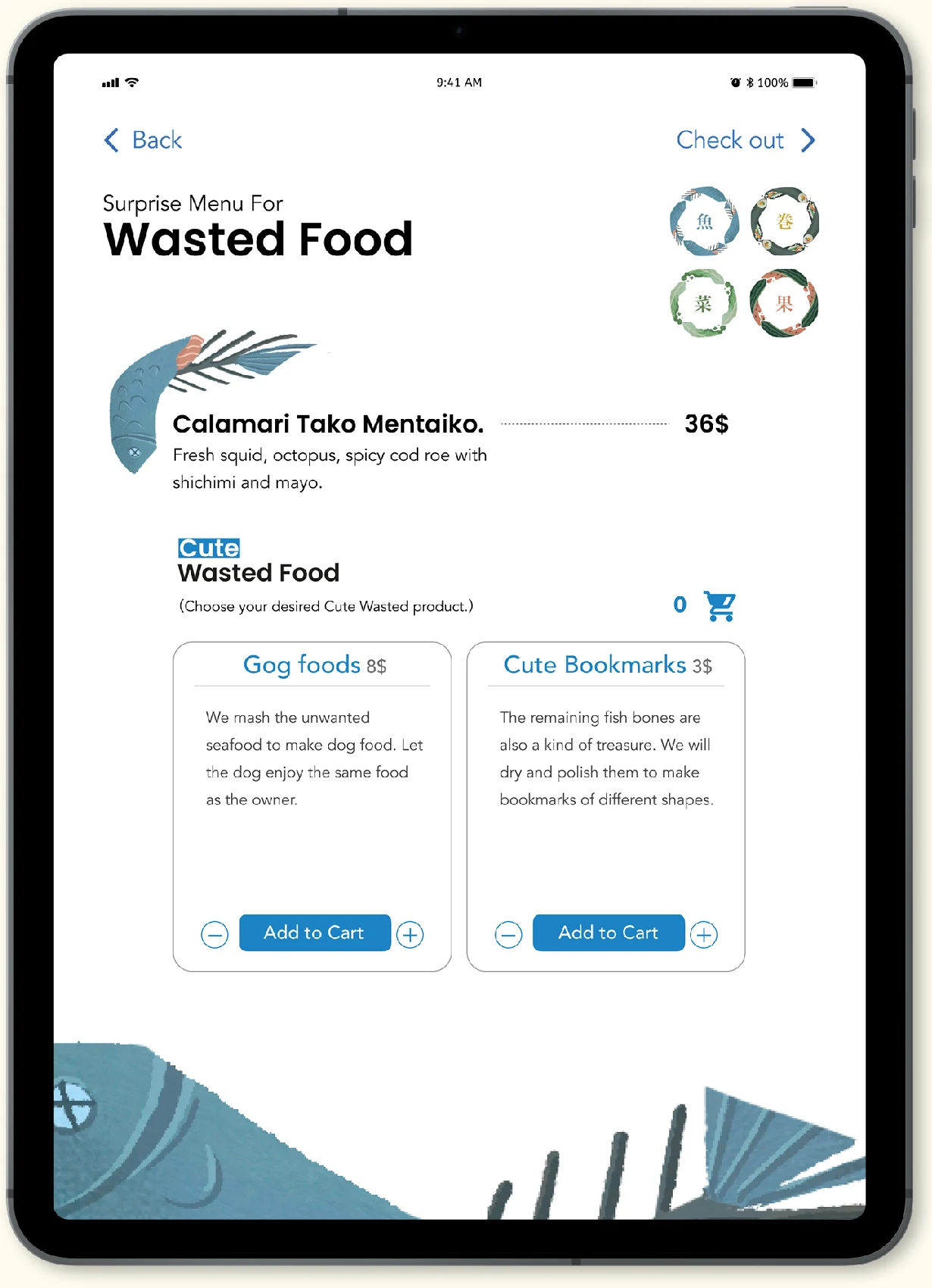
Calamari Tako Mentaiko
A seafood dish paired with concepts for making use of fish trimmings and bones.
Pet food · Decorative bookmarks
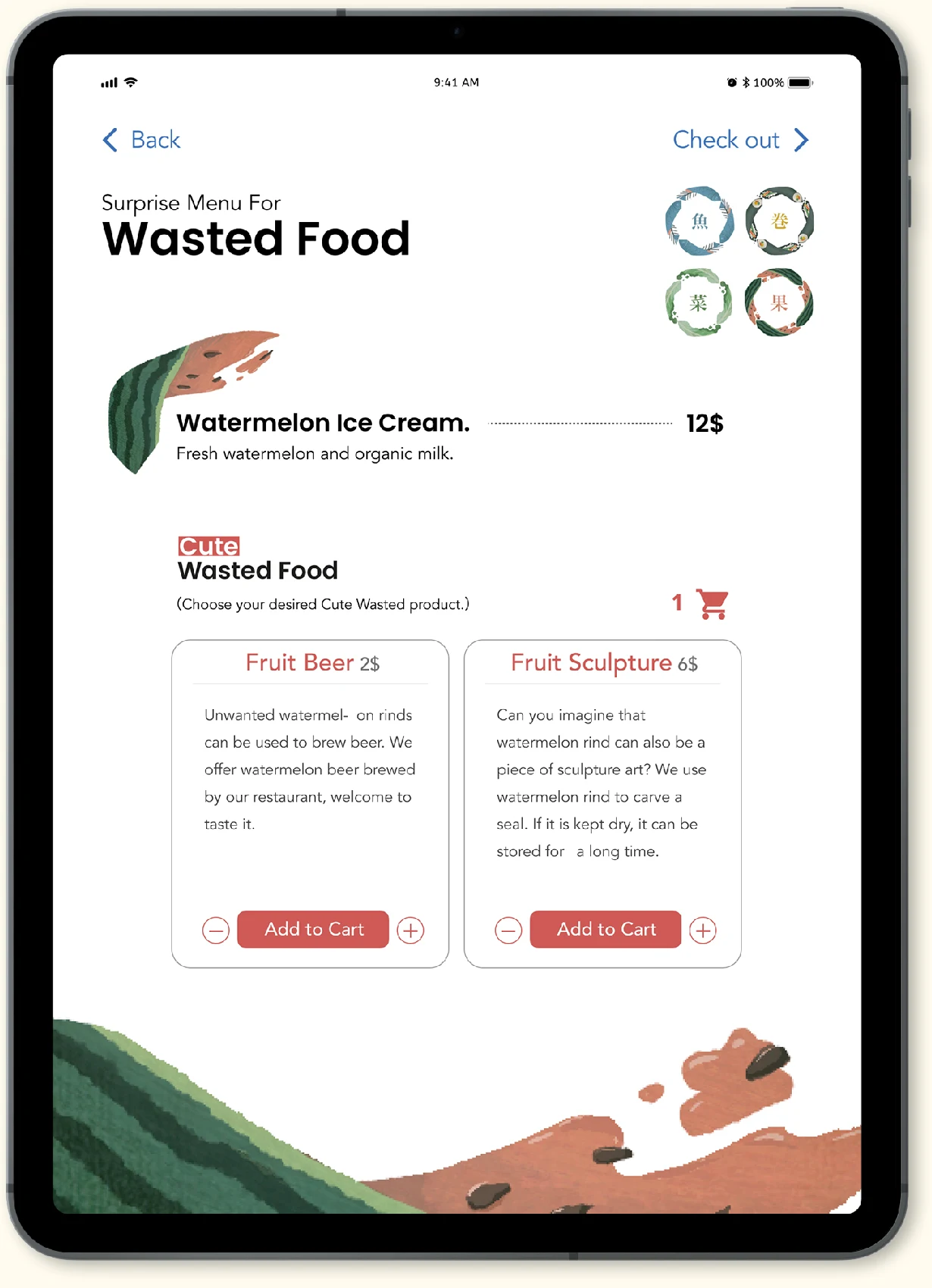
Watermelon Ice Cream
A fruit dessert paired with ideas for repurposing watermelon rind.
Fruit beer · Fruit sculptures
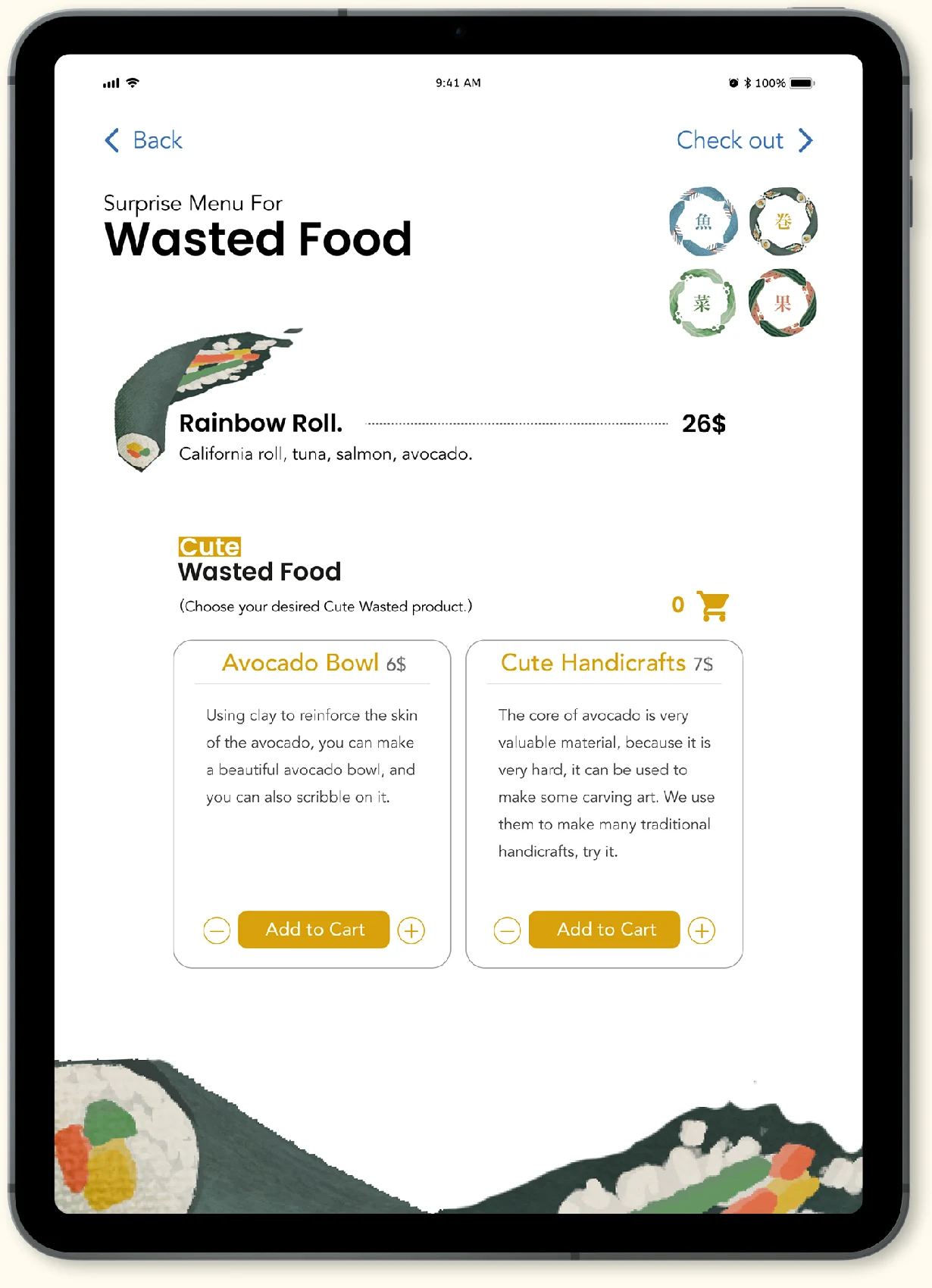
Rainbow Roll
A roll paired with ideas for giving avocado skins and seeds another use.
Avocado bowl · Handicrafts
These are design concepts for exploring ingredient reuse, rather than validated food-production methods or measured sustainability outcomes.
16 / Special menu
03 — Review and check out
What can I get?
The cart brings main dishes and their related products together. Customers review quantities and the total before checking out.
The intended experience offers both a meal and a tangible connection to food reuse, making the idea of sustainable food development easier to understand.
View the complete original flow ↗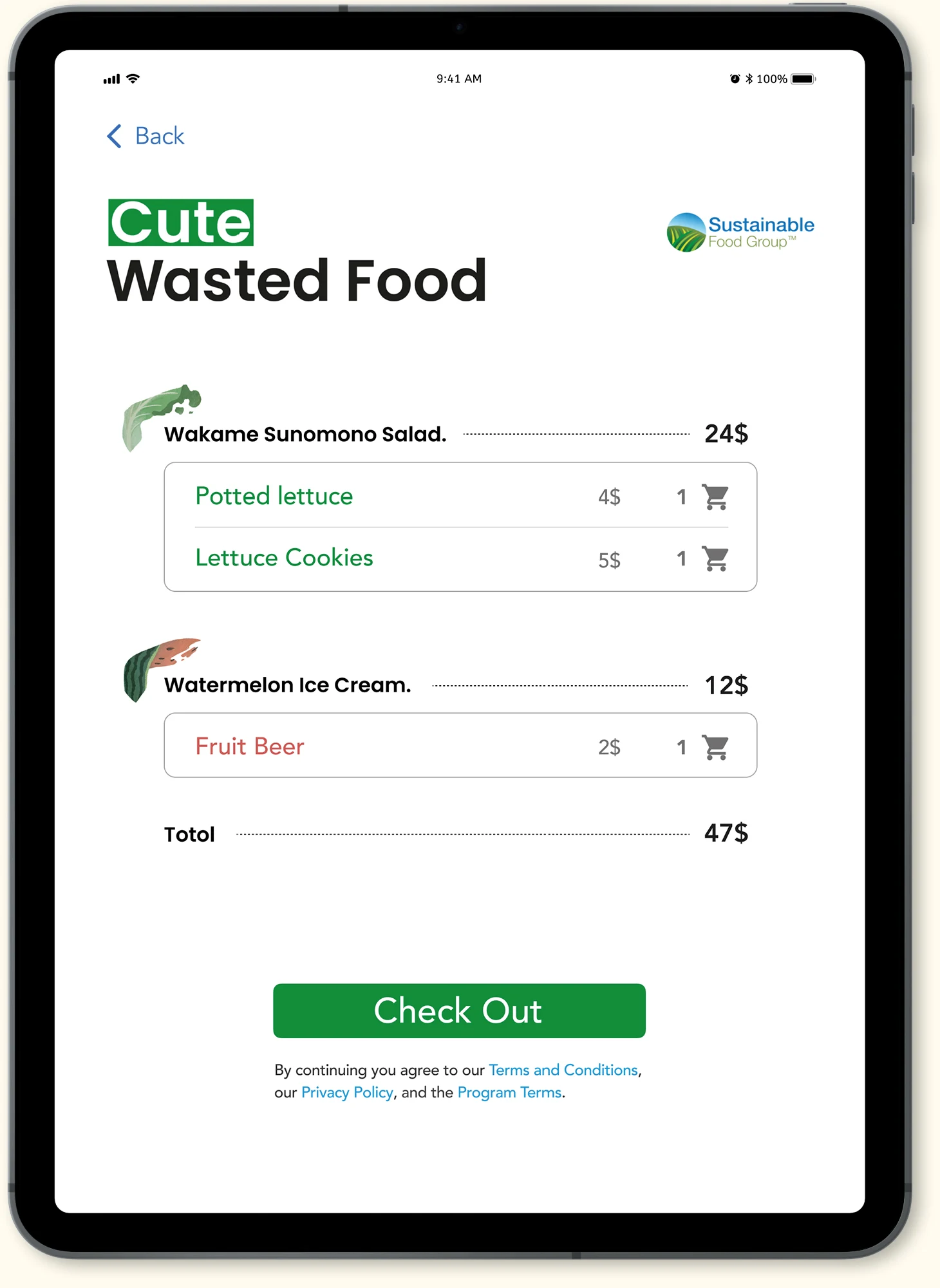
17 / Special menu
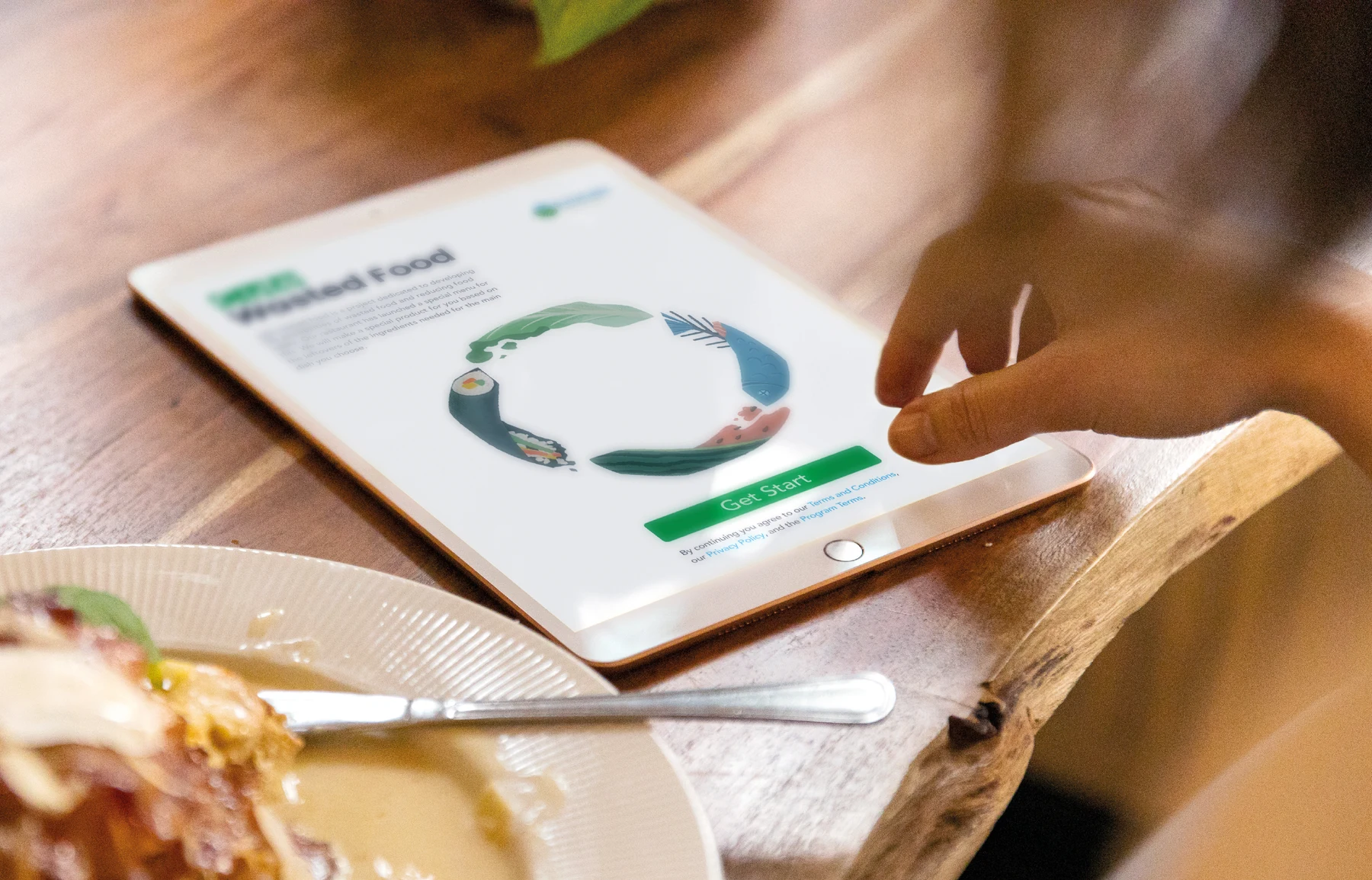
The special menu in the dining experience